
McDonald’s Burger Menu: Prices, Calories & Full Comparison (2026)
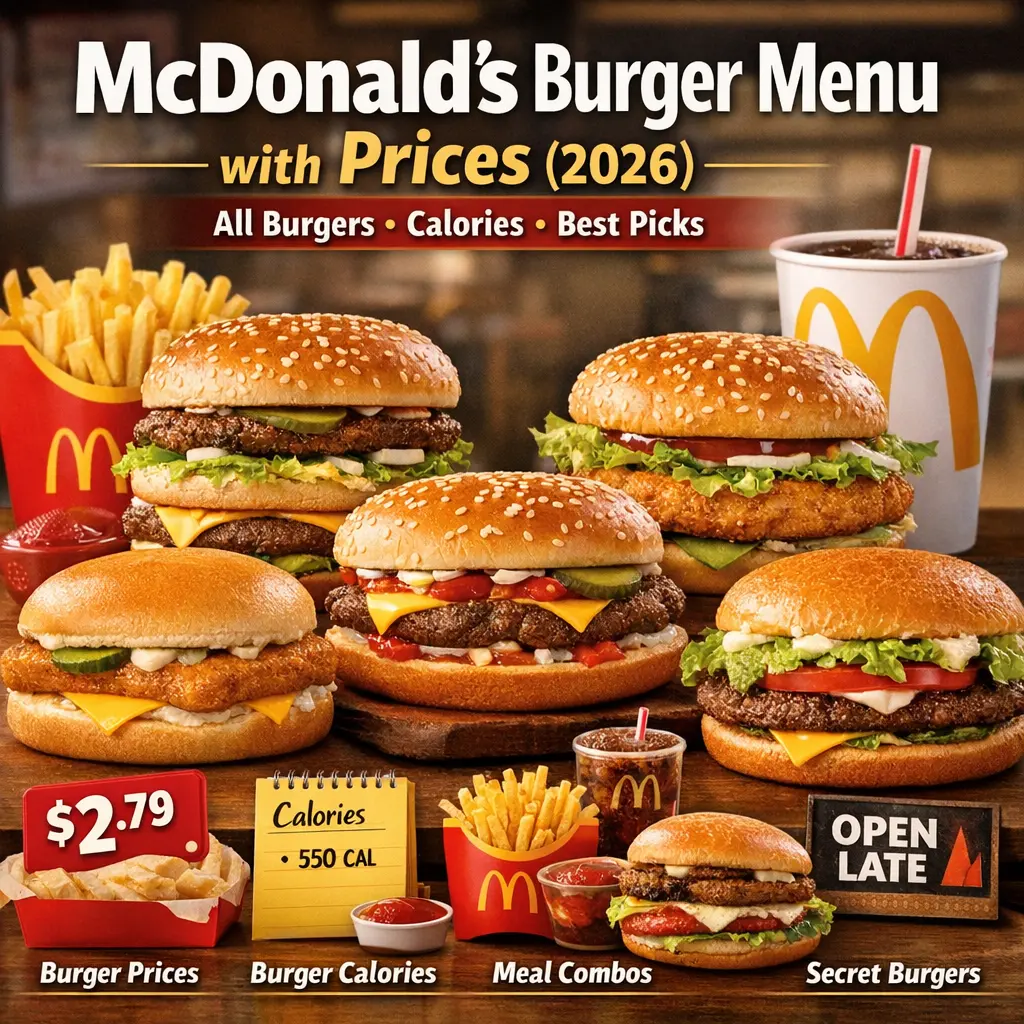
McDonald’s burger menu ranges from the 250-calorie Hamburger to the 740-calorie Double Quarter Pounder with Cheese, but the biggest burger isn’t automatically the best choice. This guide compares the 10 burgers by calories, protein, price, sodium, fat, and nutritional efficiency, then breaks down which options make the most sense for specific goals such as getting more protein, keeping calories lower, or getting better value.
What Should I Order? Quick Picks by Goal
| Goal | Best Pick | Why |
|---|---|---|
| Best protein efficiency | Double Quarter Pounder with Cheese | 15.4 cal/g protein, the best ratio among the 10 burgers compared |
| Best protein value | Double Cheeseburger | About 6.4g protein per estimated dollar |
| Lowest calories | Hamburger | 250 calories, the lowest of the 10 burgers compared |
| Most total protein | Double Quarter Pounder with Cheese | 48g protein, the highest in the comparison |
| Lowest sodium density | Daily Double | 1.65mg sodium per calorie, the lowest ratio in the comparison |
| Big Mac-style flavor for less | McDouble + Big Mac sauce + lettuce | A publicly recommended way to approximate the Big Mac flavor profile at a lower estimated price |
These picks are for readers choosing based on a specific goal, such as more protein, fewer calories, or better value. If taste and the classic build matter most, the Big Mac remains a valid choice even though it does not lead the efficiency or protein-value rankings.
Fresh Beef vs. Frozen: What’s Actually Different
This is the main production difference across McDonald’s U.S. burger lineup. According to McDonald’s official burger information, the Quarter Pounder line uses fresh, never-frozen beef cooked when you order at most participating restaurants in the contiguous U.S., while standard patties used in burgers such as the Hamburger, Cheeseburger, McDouble, Daily Double, and Big Mac are ground, formed, and flash-frozen. McDonald’s says the frozen patties typically take about two to three weeks from forming to serving.
The Quarter Pounder line also ranks highly in the calories-per-gram-of-protein comparison, occupying three of the top four spots. That is a separate finding from the fresh-beef distinction: the ranking reflects each burger’s complete recipe and nutrition profile, not evidence that fresh beef itself causes better protein efficiency.
Is McDonald’s Beef Really “100% Beef”?
Yes. McDonald’s states that its U.S. beef patties are made with 100% real beef, with salt and pepper used for seasoning, and contain no fillers, additives, or preservatives. McDonald’s says the beef comes from cuts including chuck, round, and sirloin.
Claims that McDonald’s uses unusual fillers or a company supposedly called “100% Beef” are longstanding food myths, not documented ingredients or sourcing practices.
Full Burger Comparison
Figures from McDonald’s official Nutrition Calculator, checked October 30, 2026; prices are reference estimates.
mcdonaldssmenu.com · Burger Quick Compare
Nutrition & Price
| Burger | Est. Price | Calories | Fat | Carbs | Sodium | Protein |
|---|---|---|---|---|---|---|
| Hamburger | $1.99–2.69 | 250 | 9g | 30g | 510mg | 12g |
| Cheeseburger | $1.99–2.99 | 300 | 13g | 31g | 720mg | 15g |
| McDouble® | $3.49–3.99 | 390 | 20g | 32g | 920mg | 22g |
| Double Cheeseburger | $3.79–3.99 | 440 | 24g | 34g | 1,120mg | 25g |
| Daily Double | $4.19–4.39 | 490 | 31g | 30g | 810mg | 22g |
| Quarter Pounder® with Cheese | $5.79–6.49 | 520 | 26g | 42g | 1,140mg | 30g |
| Quarter Pounder® with Cheese Deluxe | $6.29–6.99 | 630 | 37g | 44g | 1,210mg | 30g |
| Bacon Quarter Pounder® with Cheese | $7.29–7.59 | 630 | 35g | 43g | 1,470mg | 36g |
| Double Quarter Pounder® with Cheese | $7.99–8.99 | 740 | 42g | 43g | 1,360mg | 48g |
| Big Mac® | $4.99–6.99 | 580 | 34g | 45g | 1,060mg | 25g |
Note: the Daily Double’s availability varies by restaurant — it has historically been a limited/regional item, so check the app if your location doesn’t list it.
How to read it: Prices are reference estimates and can vary by restaurant, location, and ordering channel. Nutrition figures are based on McDonald’s official U.S. Nutrition Calculator and standard menu formulations. Figures checked October 30, 2026. The comparisons below are calculated from these underlying nutrition figures and estimated prices.
Ranked: Calories Per Gram of Protein
Lower is more protein-efficient: fewer calories are required to provide each gram of protein.
| Rank | Burger | Calories per gram of protein |
|---|---|---|
| 1 (best) | Double Quarter Pounder with Cheese | 15.4 |
| 2 | Quarter Pounder with Cheese | 17.3 |
| 3 | Bacon Quarter Pounder with Cheese | 17.5 |
| 4 | Double Cheeseburger | 17.6 |
| 5 | McDouble | 17.7 |
| 6 | Cheeseburger | 20.0 |
| 7 | Hamburger | 20.8 |
| 8 | Quarter Pounder with Cheese Deluxe | 21.0 |
| 9 | Daily Double | 22.3 |
| 10 (weakest) | Big Mac | 23.2 |
The interesting result isn’t simply that the Double Quarter Pounder ranks first. The top three most protein-efficient burgers, the Double Quarter Pounder with Cheese, Quarter Pounder with Cheese, and Bacon Quarter Pounder with Cheese, are all from the Quarter Pounder/fresh-beef line, while the Big Mac ranks last at 23.2 cal/g. The next two spots, Double Cheeseburger and McDouble, are held by standard flash-frozen burgers achieving similarly strong efficiency (17.6 and 17.7 cal/g), a reminder that the ranking reflects each burger’s complete nutritional composition, not the fresh-versus-frozen distinction by itself.
Worth noting for value shoppers: McDouble sits at 17.7 cal/g for an estimated $3.74 midpoint price, close behind the Quarter Pounder line’s 17.3–17.5 cal/g results that cost roughly double. If you’re comparing efficiency rather than simply wanting the larger burger, McDouble gets you nearly the same ratio for meaningfully less money.
Ranked: Protein Per Dollar: Which Burger Gives You the Most Protein for Your Money?
Protein-per-dollar estimates how much protein you get for each dollar spent, using the midpoint of each estimated price range. Higher is better value for protein. Actual prices vary by restaurant, location, and ordering channel, so these figures are best used for comparison rather than as exact menu prices.
| Rank | Burger | Protein per $1 |
|---|---|---|
| 1 (best) | Double Cheeseburger | 6.43g |
| 2 | Cheeseburger | 6.02g |
| 3 | McDouble | 5.88g |
| 4 | Double Quarter Pounder with Cheese | 5.65g |
| 5 (tie) | Hamburger | 5.13g |
| 5 (tie) | Daily Double | 5.13g |
| 7 | Quarter Pounder with Cheese | 4.89g |
| 8 | Bacon Quarter Pounder with Cheese | 4.84g |
| 9 | Quarter Pounder with Cheese Deluxe | 4.52g |
| 10 (weakest) | Big Mac | 4.17g |
The Double Cheeseburger is the strongest protein-per-dollar choice in this comparison, delivering about 6.43g of protein per estimated dollar. The Cheeseburger and McDouble are close behind at about 6.02g and 5.88g respectively, so the gap among the top three is relatively small.
The Big Mac ranks last at about 4.17g of protein per dollar. That doesn’t mean it’s a poor choice overall; it means you’re paying more for its specific Big Mac build (signature sauce, middle bun, cheese, and toppings) rather than maximizing protein for your money.
Sodium Density: Which Burgers Rank Higher Than Their Calorie Count Suggests
Ranked by milligrams of sodium per calorie, not just total sodium:
| Item | Sodium/Calorie |
|---|---|
| Double Cheeseburger | 2.55 mg/cal (highest sodium density) |
| Cheeseburger | 2.40 mg/cal |
| McDouble | 2.36 mg/cal |
| Bacon Quarter Pounder with Cheese | 2.33 mg/cal |
| Quarter Pounder with Cheese | 2.19 mg/cal |
| Hamburger | 2.04 mg/cal |
| Quarter Pounder with Cheese Deluxe | 1.92 mg/cal |
| Double Quarter Pounder with Cheese | 1.84 mg/cal |
| Big Mac | 1.83 mg/cal |
| Daily Double | 1.65 mg/cal (lowest sodium density) |
This one is genuinely counter-intuitive. The Double Cheeseburger, which sounds like a straightforward, unremarkable option, has the highest sodium density of any burger, higher than the Big Mac or any Quarter Pounder. The Daily Double, a double-patty burger that looks like it should be near the top of that list, is actually the least sodium-dense burger per calorie on the whole menu at 1.65mg/cal, even lower than the Big Mac’s 1.83mg/cal despite the Daily Double carrying less absolute sodium too (810mg vs. 1,060mg). Absolute sodium and sodium density tell different stories; check whichever one matters for your situation.
Fat as a Share of Calories
This shows what percentage of each burger’s calories comes from fat, calculated from the listed fat grams using 9 calories per gram of fat. It measures fat concentration, not total fat intake. A burger can have a lower percentage but still contain more total grams of fat because it is larger.
| Burger | Calories from Fat |
|---|---|
| Hamburger | 32% (lowest) |
| Cheeseburger | 39% |
| Quarter Pounder with Cheese | 45% |
| McDouble | 46% |
| Double Cheeseburger | 49% |
| Bacon Quarter Pounder with Cheese | 50% |
| Double Quarter Pounder with Cheese | 51% |
| Big Mac | 53% |
| Quarter Pounder with Cheese Deluxe | 53% |
| Daily Double | 57% (highest) |
The Hamburger is the clear outlier, with only about 32% of its calories coming from fat. The Daily Double is at the other end at about 57%, the highest share in this comparison, just ahead of the Big Mac and Quarter Pounder with Cheese Deluxe, which both sit around 53%.
That doesn’t automatically make the Hamburger the “healthiest” burger or the Big Mac the “worst.” Fat share answers a narrower question: how calorie-dense the burger’s energy is from fat. If you’re deciding what to order, total calories, total fat, protein, sodium, and price can tell you very different things.
One useful pattern stands out: the burgers with two patties, bacon, or extra toppings generally move toward the 50%+ range, while the plain Hamburger stays well below it at 32%. The Daily Double, at 57%, pushes furthest into that range of anything on the menu, even though it carries no bacon or extra cheese, which suggests the plain double-patty-and-bun ratio itself is enough to drive fat share higher than most bacon- or cheese-added builds.
A Real, Documented Way to Order the Big Mac Flavor for Less
Former McDonald’s culinary executive Mike Haracz has publicly recommended ordering a McDouble with Big Mac sauce and shredded lettuce instead of the standard toppings, no middle bun, as a lower-cost way to get a similar flavor profile, roughly $2 less by his estimate. It’s also a better result on the calories-per-gram-of-protein metric: McDouble’s 17.7 cal/g beats the Big Mac’s 23.2 outright. Whether the taste holds up is for the reader to judge, but the substitution itself is a real, publicly documented recommendation, not an internet myth.
Burger Value: McValue Deals
McDonald’s burger value runs on the McValue platform (ongoing at participating restaurants). The McDouble is on the Under $3 Menu. The McChicken Meal Deal is $5 and the McDouble Meal Deal is $6 — each with 4-piece Chicken McNuggets, small fries, and a small drink. From November 2, 2026, a Quarter Pounder with Cheese meal deal (medium fries and a drink) is $8. Prices and participation vary by restaurant; delivery is excluded from the meal deals.
FAQ
Which McDonald’s burger has the best protein-per-calorie ratio?
The Double Quarter Pounder with Cheese, at 15.4 calories per gram of protein, has the best ratio among the 10 burgers compared.
Which McDonald’s burger gives you the most protein for the money?
The Double Cheeseburger, at about 6.4g of protein per estimated dollar, ranks first for protein-per-dollar. Actual value varies with local pricing.
Is McDonald’s beef fresh or frozen?
Both, depending on the burger. The Quarter Pounder with Cheese line uses fresh, never-frozen beef cooked to order, while the Big Mac, McDouble, Hamburger, and other standard patties use flash-frozen beef.
Is McDonald’s beef really 100% beef?
Yes. McDonald’s states that its beef patties contain beef, salt, and pepper, with no fillers, additives, or preservatives.
What’s the lowest-calorie burger at McDonald’s?
The Hamburger, at 250 calories, is the lowest-calorie burger in this comparison. It also has the lowest share of calories from fat at 32%.
Which McDonald’s burger has the most sodium?
The Bacon Quarter Pounder with Cheese has the highest total sodium at 1,470mg. However, the Double Cheeseburger has the highest sodium density at 2.55mg per calorie, so total sodium and sodium density give different answers.
Why does the Big Mac rank low for protein efficiency and value?
The Big Mac’s extra bun layer and sauce add calories and cost without adding protein in proportion to several other burgers in the comparison. It therefore ranks last for both calories per gram of protein (23.2) and protein per estimated dollar (4.2g), even though its signature flavor and build are the reason many people choose it.
Which McDonald’s burger should I order if I want the best overall value?
There isn’t one universal winner. Choose the Double Quarter Pounder with Cheese for protein efficiency, the Double Cheeseburger for protein value, or the Hamburger if minimizing calories is your priority.
The Bottom Line
There isn’t one best McDonald’s burger for everyone. The Double Quarter Pounder with Cheese stands out for protein efficiency and total protein, the Double Cheeseburger offers the best protein value for its estimated price, and the Hamburger is the lowest-calorie option among the 10 burgers compared. For a broader look at McDonald’s items, prices, and nutrition, see our McDonald’s menu with prices and calories.
The Big Mac is a different kind of choice: its signature sauce and classic three-layer build matter more than maximizing protein or value. If fresh beef matters to you, the Quarter Pounder line uses fresh, never-frozen beef at most participating restaurants in the contiguous U.S., while standard beef patties are flash-frozen.
Last verification pass: October 30, 2026 · Not affiliated with or endorsed by McDonald’s Corporation.